Written by Nina McGinnis, our 2026 January-term intern through UVA’s EI program
Environmental scientists love shorthand – BMPs, TMDLs, MS4s – but when the acronyms pile up, the joke’s on us. When speaking with non-technical audiences, your shorthand becomes an inside joke no one else gets. So, always remember LMAO, Language Matters for Audience Outreach. 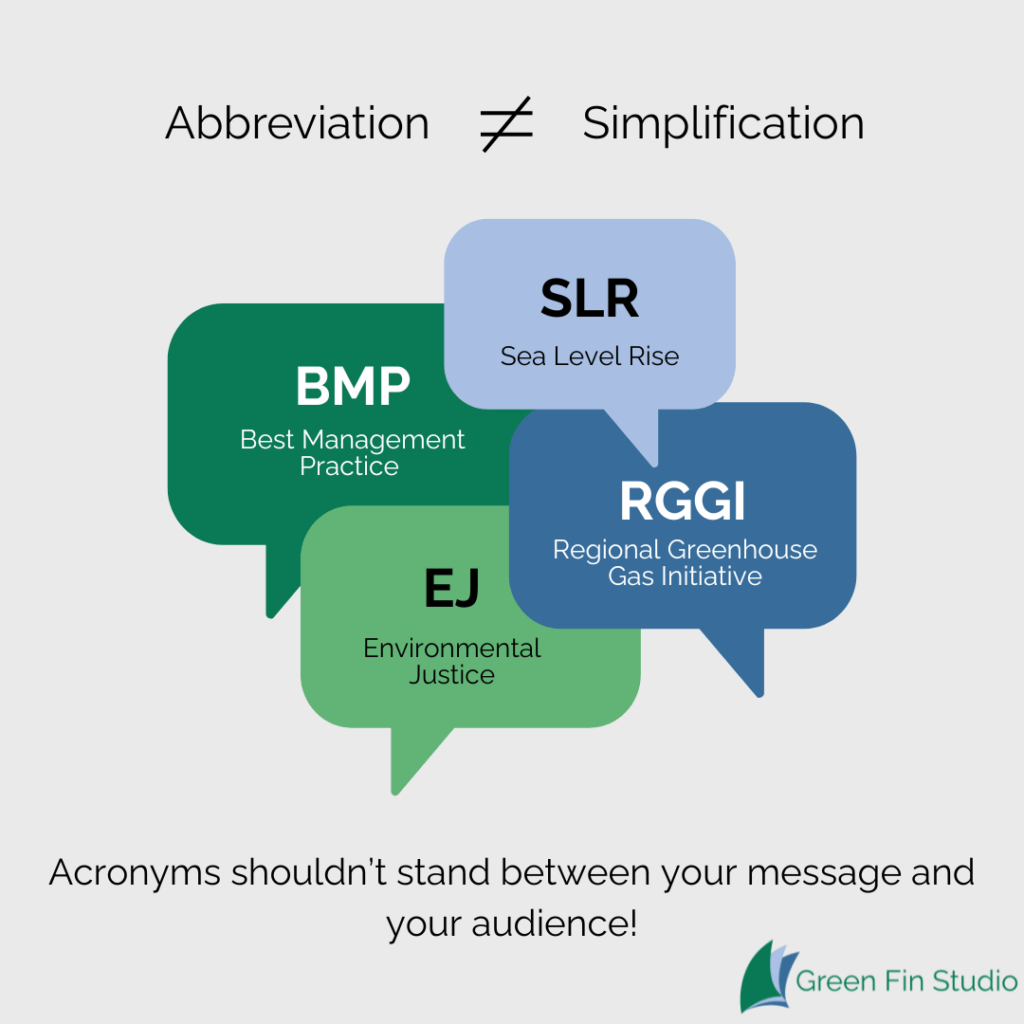
Acronyms can be extremely handy for shortening long titles or repetitive phrases, speeding up a conversation between individuals familiar with the topic. For example, Best Management Practices are a common topic in the environmental field, so the shorthand “BMP” is an effective time-saver between seasoned environmental scientists and managers. But for a landowner being asked to implement a BMP, they need context and examples. Even spelled out, the phrase does not communicate why or how to protect water quality from non-point source pollution – in fact, it doesn’t even hint at its relation to water or pollution! Instead of using BMP as the shorthand, call out specific practices by name – cover crops and manure transport for agriculture audiences, tree planting and rain gardens for residential audiences, and dry detention pods and stormwater retrofits for urban government audiences.
When a listener hears an unfamiliar acronym that the speaker does not explain, it creates a feeling of exclusion. The thought may arise: I should know this, but I don’t, leading to less engagement in the exchange. Asking for clarification can be embarrassing, or the conversation may move too quickly to pose questions. As the communicator, try to read your audience. Say the full name or phrase for the first time or two, followed by the acronym. If they don’t seem to have caught on, repeat it, or reiterate its significance. This change only requires a few extra words but can reap enormous benefits in understanding.
The same is true of jargon. While it is useful for communication between scientists well-versed in their field, such language excludes non-experts and leads to confusion with wider audiences. As with unfamiliar acronyms, jargon disrupts the fluency of understanding in a conversation, reducing the audience’s engagement with a topic. For example, “Agroforestry” is a mouthful without an obvious meaning. To an unfamiliar ear, it is forgettable, and the broader goal of the communication is lost. “A sustainable method of farming combining agriculture with trees,” on the other hand, is visual, easily digestible, and interesting. “Bioaccumulation” is loaded with meaning, but “the buildup of harmful substances in a living thing” is more likely to translate effectively to someone outside the science realm. Again, there is a time and place for specialized vocabulary. But when engaging wider audiences, it’s best to stick to simpler, understandable explanations instead of jumping straight to jargon.
Both jargon and acronyms rely on assumed background knowledge– something that is never guaranteed. When possible, skip the jargon altogether and explain your acronyms. A thoughtful conservation that covers context and engages the listener is always better than a soliloquy of big words. (See?) With this careful consideration of language and audience, you’ll turn a private joke into understanding that everyone can share. LMAO!


